
John Crichton-Stuart, the 3rd Marquess of Bute (1847 – 1900), was simply known as Lord Bute. The Bute family played an important part in Cardiff’s modern history and Lord Bute was the driving force behind the reconstruction of Castell Coch.
The young Bute inherited a vast fortune as was, perhaps, the richest man in the world. His father invested heavily in Cardiff and Bute’s interest in medievalism and architecture led to the creation of two Cardiff castles.
He accepted the offer to be Mayor of Cardiff in 1890 – 91.
The Marquess married Gwendolen Mary Angela Fitzalan-Howard in 1872. Lady Bute was an accomplished horsewoman who enjoyed pony carriage driving and rowing. She played a significant part in the development of Castell Coch.
Books
I have several books about the Scottish aristocrat. “The Grand Designer” by Rosemary Hannah is highly recommended. You can buy a second hand copy for about £20 – 30.
“John Patrick, Third Marquess of Bute, K.T., 1847-1900; a Memoir” by Sir David Hunter-Blair is a comprehensive history of Bute’s life. “K.T.” stands for Knight of the Thistle. He was invested as a Knight of the Order of the Thistle in 1875.
“Cardiff and the Marquess of Bute” by John Davies is a fascinating history of the Bute family’s impact on the city of Cardiff. The author focuses on the 3rd Marquess and his legacy in Cardiff. Later revisions of this book can be purchased second hand for about £15.


Photos
I’ve collected a few original photos of Lord Bute. They show the Marquess of Bute in different stages of his life.
The first photo from my collection shows Bute as a young man. I’ve digitally restored it to remove dust and blemishes.
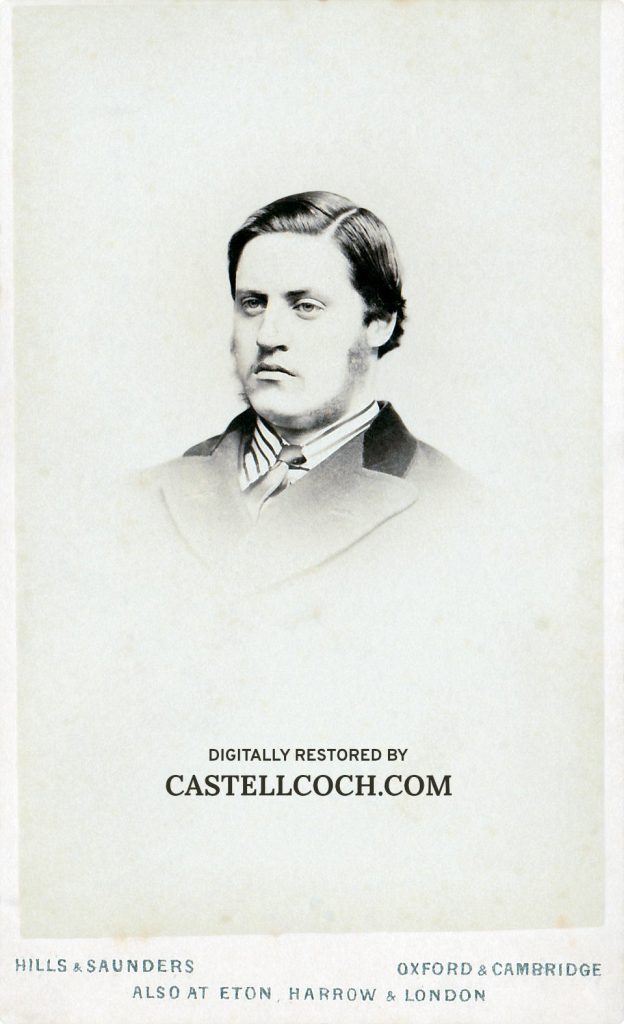
Young Lord Bute
This photo of John Crichton-Stuart is a “carte de visite” or “CDV”. These small photographs, 11.4 x 6.3 cm in size, were popular in the 1860s. They were replaced in the following decade by cheaper formats.
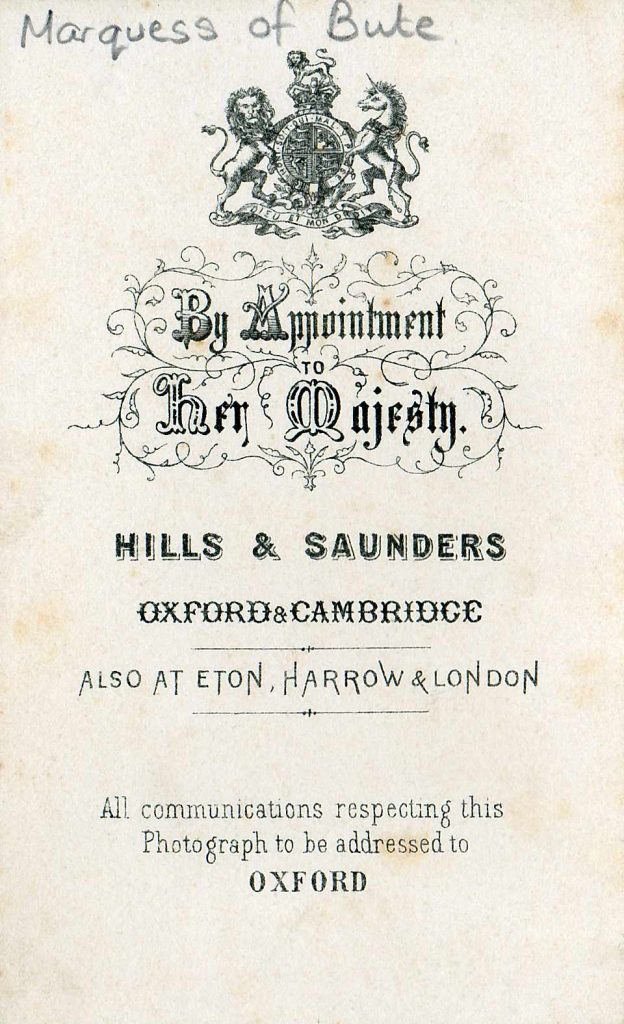
The image was taken by Hills & Saunders, who were given a Royal Warrant as photographers to Queen Victoria in 1867.
Bute was 20 in 1867 so maybe this photo was taken to commemorate his 21st birthday.
Caricatures of Bute
Lord Bute was featured in two publications at the start of the 1870s.
After marrying on April 16th 1872, The Hornet published a caricature the following week simply titled “Married”. The Marques is referred to as “The Golden Calf” due to his immense wealth.

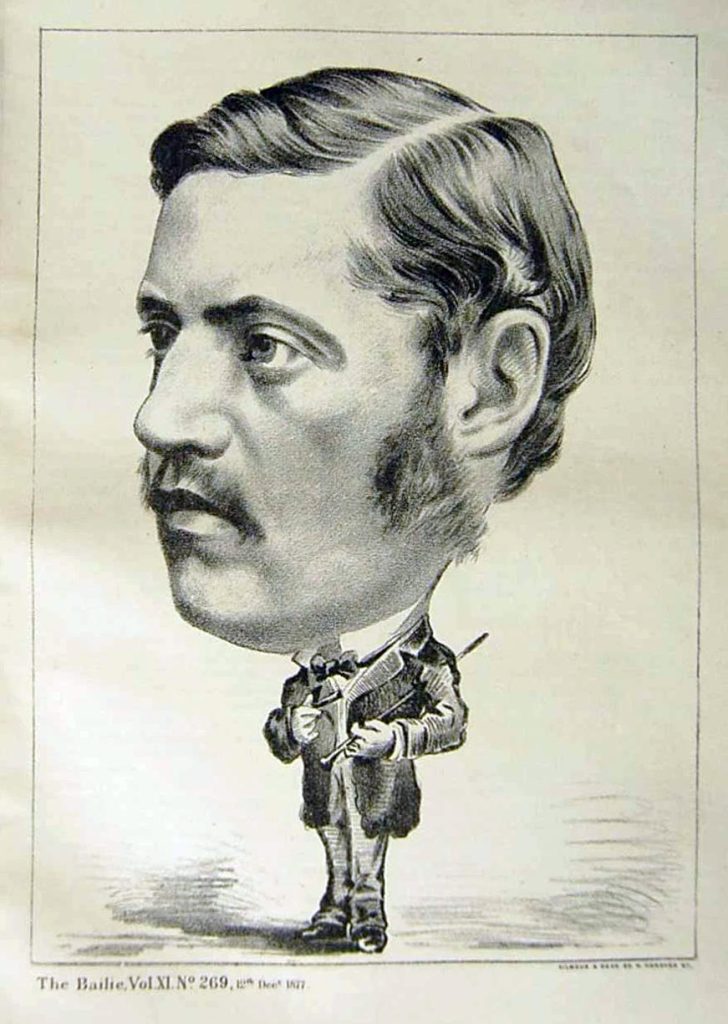
The Bailie was a Scottish publication, founded in 1872. It was known for its cartoons and illustrations. Lord Bute was included in their “Men You May Know” series in 1877.
Hills & Saunders
Hills & Saunders was a leading Victorian photographic firm. It was founded in 1860 and they were given a Royal Warrant as photographers to Queen Victoria in 1867.
Robert Hills and John Henry Saunders ended their partnership in 1889.
I have another couple of original photos of Lord Bute that I’ll share in Part 2.
Sources
The photo of Lord Bute is from my own collection. I’ve digitally restored it to remove dust and blemishes.
- Caricature of Lord Bute in The Hornet – National Portrait Gallery, London
- Caricature of Lord Bute in The Bailie – Source Unknown
- John Crichton-Stuart, 3rd Marquess of Bute on Wikipedia


A fascinating insight into Lord Bute, he’s a character I’ve heard a lot about since I moved to Cardiff, but not at this level of detail. Thanks for the hard work collating and sensemaking it.
A family story of the marquis of Bute (the Cardiff one ). Tells a story of an illegitimate child.
The story carries on that Bute discharged an Irish prisoner out of the Tower of London (his name was originally O Brien, but changed to Poole as he escaped Ireland from the English, when he landed in Liverpool)
And the Poole family in Cardiff now are my distant cousins from my Grandfather O Reiley.
Has anyone heard anything that could co oberate this ?