
I published a blog post in 2021 about the Castell Coch guidebooks from 1957 to 1975. I didn’t have the original version from 1954 at the time.
The original guide was written by Peter Floud, C.B.E. (1911 – 1960), who was the Keeper of Circulation at the Victoria and Albert Museum.
State Guardianship
After Lord Bute’s death in 1900, Lady Bute retired to Castell Coch with her daughter while the estate was settled. The castle was bequeathed to Gwen and it remained in her possession until she died in 1932 at the age of 77.
The property was only used occasionally in the summer months and as the base for the Pentyrch Hunt. It was requisitioned by the military during the Second World War.
There are some great aerial photos of the castle in the 1930s and 1940s.
The “Office of Works” was formed in 1851 and became the “Ministry of Works” in 1940. During this period, the Ancient Monuments Act (1882) and the Ancient Monuments Protection Act (1900) were introduced to protect monuments and encourage owners to place them in state guardianship.
Castell Coch was placed in the care of the Ministry of Works by the 5th Marquess of Bute in 1950.
The First Guidebook
The Ministry of Works was now responsible for preserving and managing Castell Coch so they published its first guidebook.
The department had produced very formal, text-heavy guides from the start of the 20th century for many of their sites. The famous “Ministry Blue Guides” were written by various authors between the 1920 and 1970.
They all followed a standard format that included a brief history of the site, a detailed description and a fold out map. Early editions featured a small number of black and white images.
New “souvenir” style guidebooks, that included colour pictures, were produced in the 1960s for some larger attractions.
The first editions were typically green before the blue style was adopted.
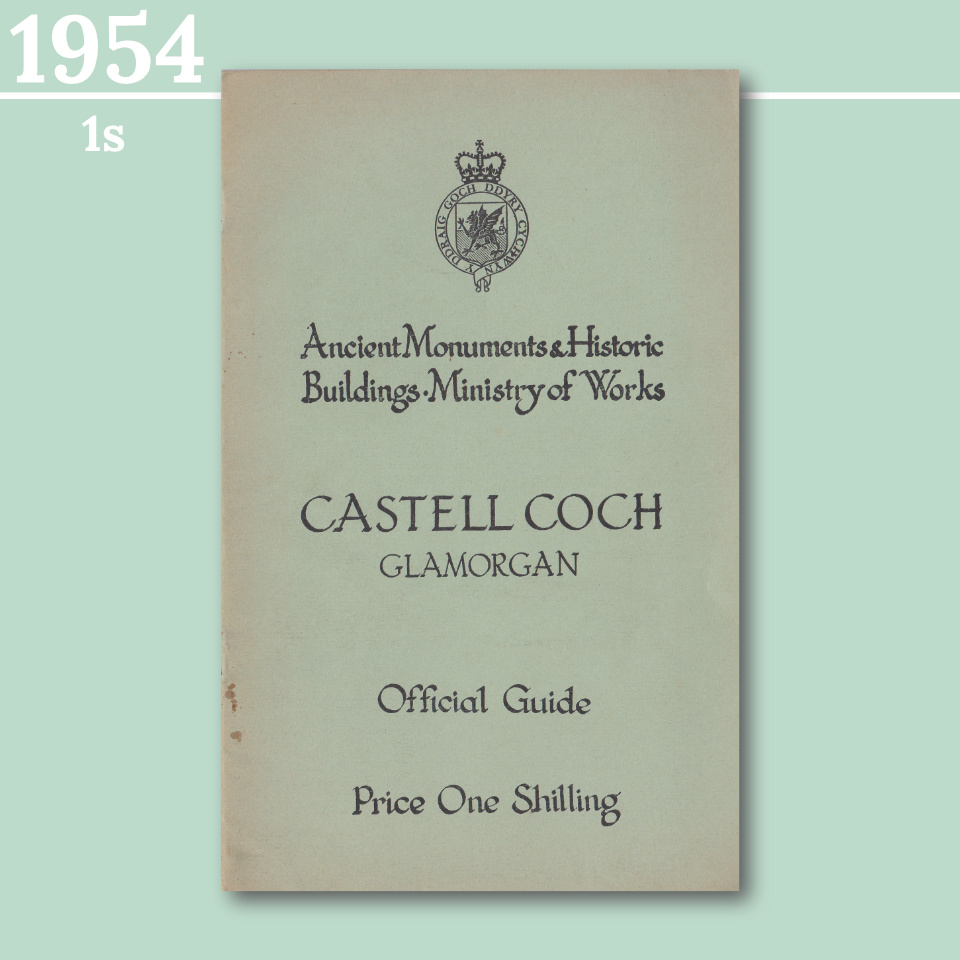
The front cover is very plain, with a small illustration and text in a simple serif typeface.
The illustration is a version of the 1953 augmented Royal Badge of Wales – the drawing of the dragon is significantly different and the crown/ribbon detail is very nicely simplified.
Information
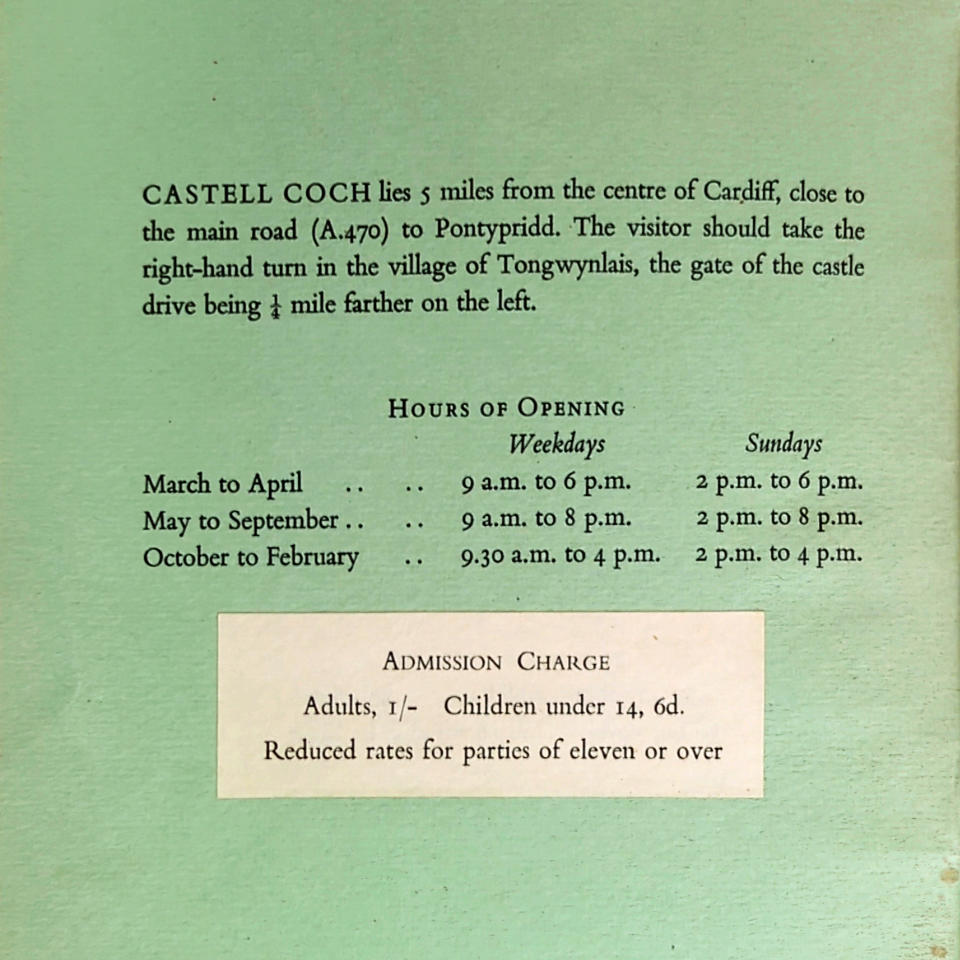
The inside cover details the castle’s location, opening times and admission prices.
Visiting the castle in 1954 cost 1 shilling (12p) for adults and 6d (6p) for children under 14.
Contents
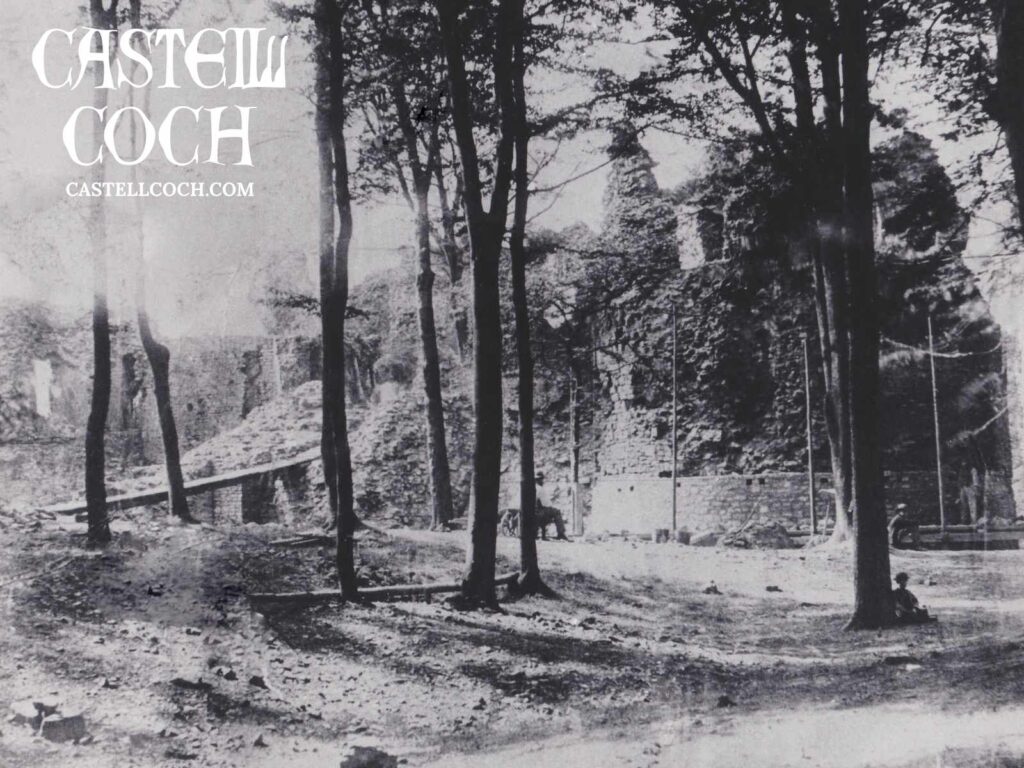
The guidebook dedicates three pages to the history of Castell Coch, detailed descriptions of various parts of the castle and a brief conclusion. The appendix lists all the ancient buildings managed by the Ministry of Works. There are two plates included, one shows a cross-section of the castle from Burges’ Report of 1872 and the other is this photo from 1875 showing the ruins before work began.
- History
- Description
- The Exterior
- The Entrance
- The Courtyard
- The Banqueting Hall
- The Drawing Room
- The Windlass Room
- The Lord’s Bedroom
- The Lady’s Bedroom
- The Curtain Wall
- The Well Tower
- Conclusion
- Appendix
Plan
The book contains a fold-out plan of the castle at courtyard level.

A Costly Folly
Peter Floud opens with a provocative view that’s still held by some people to this day. The comment “It’s not a proper castle!” is frequently posted online.
Castell Coch is in many ways a gigantic sham, a costly folly erected less than 100 years ago by an eccentric Victorian architect to satisfy the antiquarian yearnings of a wealthy nobleman.
Peter Floud – Castell Coch official guidebook (1954)
He contrasts this by explaining why he thinks it’s worth preserving.
Yet it has been thought worthy to be taken over and preserved as a national monument – for two good reasons. It successfully reproduces the appearance of a type of thirteenth-century Welsh castle of which no authentic example survives intact, and its interior is a particularly striking example of Victorian imaginative decoration at its most original and exuberant.
Peter Floud – Castell Coch official guidebook (1954)
1957 – 1975
The next versions of the guidebook are explored in this post. The number of photos increase in later editions and a short Welsh language chapter is eventually added. The contents don’t change significantly until its update in 1985.
I’ve recently completed the collection of guidebooks from 1985 to 2010 and will feature them in a future article.
Sources
- The Ministry of Works and Souvenir Guides by David W. J. Gill
- Heritage Futures

