
Cadw recently announced a report that determines the original colour of the woodwork at Castell Coch.
If you’ve visited Castell Coch recently, you’ll be familiar with the deep red paint on the joinery all around the famous landmark.
This new research shows the paintwork was a more orange shade of red when the castle was constructed in 1881. Repainting has already started and you can see below what the new paint looks like.
I contacted Lisa Oestreicher, the independent paint analyst who did the research to find out more about the process. The report is very detailed and includes analysis of 20 samples taken from various locations around the castle.
Paint Research Report
The report identified 16 different phases of decoration from the castle’s construction in 1881. This tells us the woodwork was repainted every 5-10 years.
The key finding is that the original colour used was an orange shade of red, in contrast to the deep red we’re more used to.
Paint Sample 1
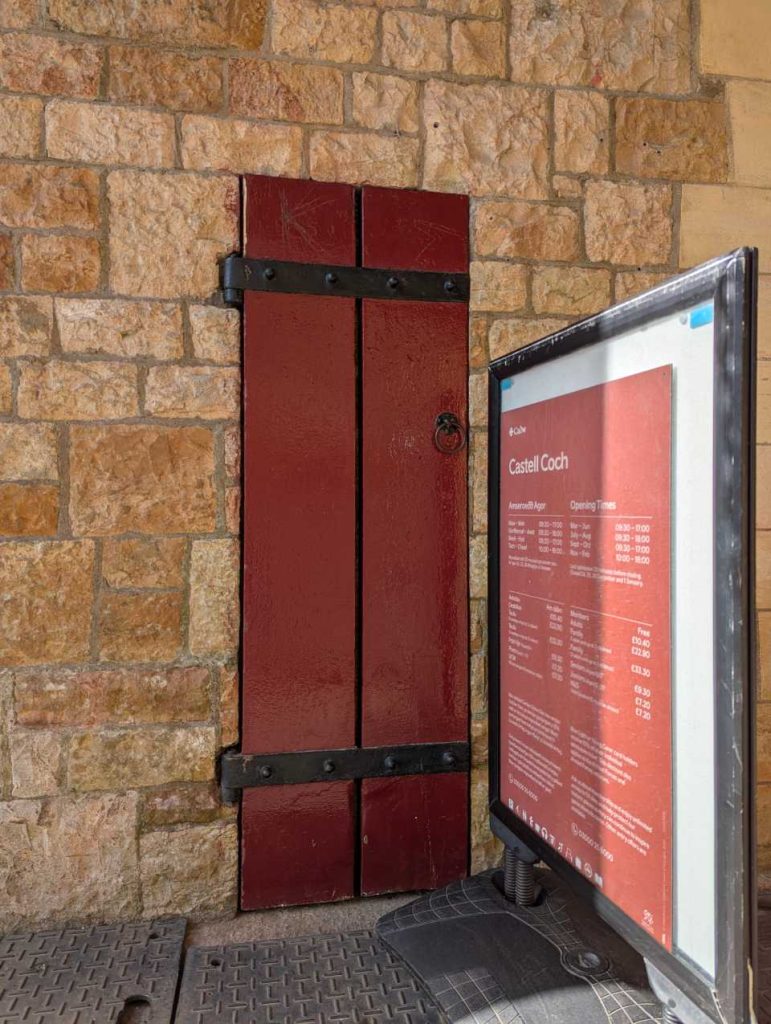
The first paint sample was taken from the inside of the false door at the entrance of the castle.
Lisa sent me this fantastic image that shows the paint sample under 10x magnification with all the different layers applied over the previous one.

- Schemes 15-16: Modern deep red paint I & III
- Scheme 14: Modern red paint
- Schemes 12-13: Modern orange-red paint II-III
- Scheme 10 & Interim: Modern dark red paint 1-11
- Scheme 8: Very deep red paint
- Scheme 7: Varnish on Orange-red paint IV
- Scheme 6: Deep red paint III on grey undercoat
- Scheme 4: Deep red paint I
- Scheme 3: Orange-red paint III on grey undercoat
- Scheme 2: Orange-red paint II on warm brown undercoat
- Scheme 1: Orange-red paint I
- Timber substrate
Sample Locations
The analysis was based on 20 samples from various locations around the castle.
Paint samples were taken from internal and external features. The samples were removed with a scalpel and dental drill before microscopic examination. Further micro-chemical tests were carried out to identify the pigments and date them.
Lisa was able to determine that the first 9 schemes were completed before c. 1960. The later 7 schemes used paint introduced after this date.
Samples taken from the balcony, drawbridge door and roof rafters show that the first coat was applied directly on the wood, without priming or an undercoat. This could have been necessary to protect the timber and only a temporary measure.
Recommendations
The report recommended using the paint finish from schemes 1-2 on the false door to colour match with artist grade acrylic paint and then use this to produce a commercial paint.
Colour Over the Years
While you might assume the “modern” deep red colour is a recent change, it was actually applied as early as scheme 4.
Red paint is notoriously subject to fading when exposed to the elements so the colour of the joinery is changing all the time. I’ve been searching through my collection of old photos and the external wooden features very rarely look deep red.
This photo shows the castle in August 2016 with the woodwork in various states of repair. It’s clearly a challenge to keep all the joinery in the same condition.

I discovered a very interesting image in my collection from July 2015. It looks like Cadw were testing new colours over a decade ago. The second colour from the left looks similar to the new red.
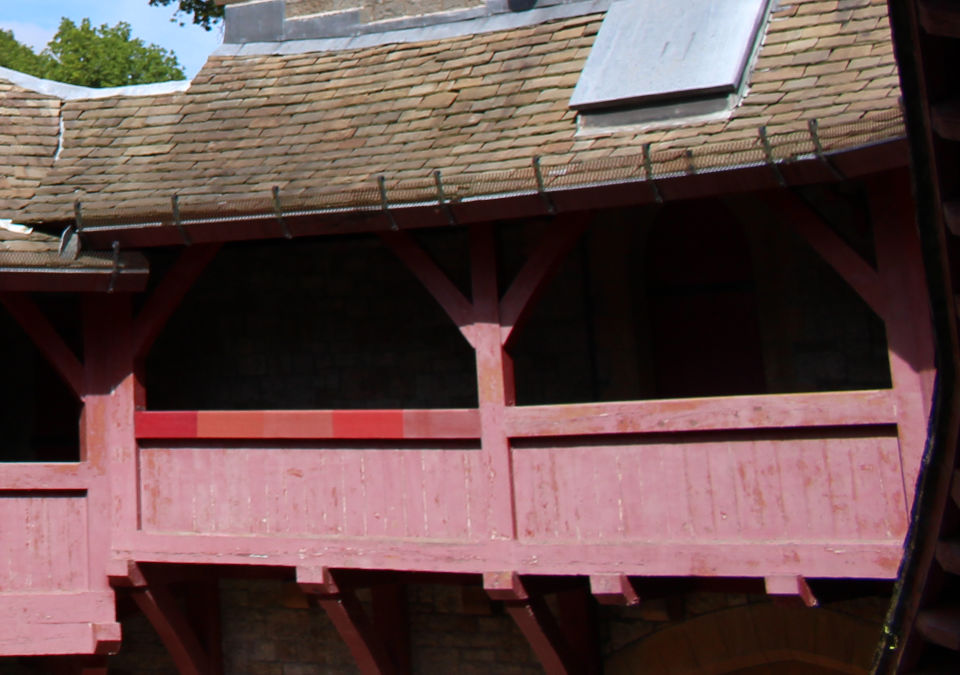
I have all the Castell Coch guidebooks, including the original from 1954. It was interesting to note that the colour of the joinery is not mentioned at all. I was hoping to find some reference to the original colour or a mention of the current colour.
The Old Castell Coch Red
This image shows the newly repainted castle in February 2018. The deep glossy red is iconic and, although not original, it’s still historic.

The New Castell Coch Red
The balcony is the first internal feature to be repainted. It’s really hard to capture the colour accurately in photos so I’ve visited a few times in different conditions. I took these photos on the 29th of May when the sky was a bit overcast. You can appreciate the orange shade more in person but the matte finish is clear to see and looks very tasteful.
In comparison, the old glossy wood looks more artificial. Some sections of the castle will be closed over the next couple of months while the painting is completed but I’d recommend a visit to see how the colours compare.

I’ll post more pictures as the work continues, so follow me on social media for updates.
Lisa has been incredibly generous with her time and I’m eternally grateful for the information and images used in this article.
Sources
- Magnified paint sample image – Lisa Oestreicher | historicpaint.com
- Paint research report – Lisa Oestreicher | historicpaint.com
- All other images – Author’s collection


I wondered why you were getting so excited about the painting when you mentioned it in your socials – but I why see now.
A fascinating piece of research well explained.
Thanks for sharing