
I picked up a copy of, “Transactions of the Cardiff Naturalists’ Society” (Volume 59 from 1926) a few years ago. It contains an article about the Castell Coch vineyard by Andrew Alexander Pettigrew.
Andrew Pettigrew’s father, also called Andrew, was Lord Bute’s Head Gardener and responsible for the creating the vineyard.
Andrew followed his two brothers (William and Hugh) in an apprenticeship with his father in the gardens of Cardiff Castle. In 1915 he took over from his brother as Cardiff’s Chief of Parks.

The Castell Coch Vineyard – Part 1
This is one of my favourite posts in the five years of this site. I love the fact this significant part of Welsh wine history happened in our little village.
I recently revisited part 1 after Welsh Wine Week concluded earlier this month and the article was mentioned in a new podcast.
Uncorked: The Welsh Wine Podcast is a new podcast exploring Wales’ thriving wine industry. Jamie Matthews, Sara Hobday and Angela Muir trace the evolution of Welsh winemaking through the centuries.
The Cardiff Naturalists’ Society
The Cardiff Naturalists’ Society was formed in 1867 and published annual Transactions from 1868 to 1986. Many of these documents have been digitised and are available on the National Library of Wales website.
They celebrated their 150th anniversary in 2017 and had an exhibition at the Cardiff Story Museum.
Volume 50 of the journal contains a report by John Stuart Corbett on the Society’s visit to Castell Coch on June 27th 1917.

Welsh Vineyards by A. A. Pettigrew

Photo by courtesy of Tim Pettigrew
This is the full text taken from the 1926 book, “Transactions of the Cardiff Naturalists’ Society”.
The Grape Vine (Vitis vinifera) is almost certainly a native of Asia Minor, and it has been cultivated in all warm temperate parts of Europe – and wine pressed from its fruit – from times unrecorded. The northern limit of its cultivation has now come to be recognized as a line starting from the mouth of the Loire (lat. 47° N.) in the west, reaching its most northerly point (52° N.) in the vicinity of Frankfurt, in Germany, and so southward again to Odessa, on the Black Sea (47° N.). For several degrees northward of this line the Vine is perfectly hardy and grows vigorously, but – other than in exceptional situations and seasons – is unable to produce and ripen fruit capable of being made into wine. This northern limit could, however, be determined only after prolonged experience, and in what follows I propose to give some account of the attempts made in our own island to grow Vines in the open air and to produce wine therefrom.
The first reference to the growing of the Grape Vine in Britain is a negative one – Tacitus (who wrote in the first century) informing us that: “with the exception of the Olive and the Vine and other trees natural to warmer climates, the soil produces fruit in considerable quantities.”
The Emperor Domitian’s edict of 92 A.D., prohibiting the cultivation of the Vine in Spain, Gaul and Britain, may imply that Vines were grown in parts of Britain prior to that date; as also may the terms of the repeal of that edict in 282 imply that vine-growing was reintroduced in that year. The earliest definite evidence we have, however, of viticulture in our island is furnished by the Venerable Bede, who (writing in the eighth century) informs us: “The island excels for grain and trees, it also produces Vines in places.”
Between this time and the Conquest occasional references to existing vineyards are found in Anglo-Saxon documents, and they are mentioned in the Laws of Alfred. Coming to Domesday Book (1086), we find 38 mentions of vineyards scattered over 14 counties, ranging southward from Suffolk and Cambridge, and including Herefordshire and Gloucestershire.
The author responsible for the Domesday contribution to the Essex Victoria County History – dealing with Domesday vineyards in general – argues that English vineyards had become extinct prior to the Conquest, and that their culture had been reintroduced by the Normans. In support of this view he points out that “the vineyards existing at the time of the Great Survey had been often newly planted since the days of the Confessor; that they had not in some cases yet begun to bear; that they were normally found in the manors held in the hands of tenants-in-chief, and probably containing a lord’s residence”; and that they were measured in French terms.
Writing towards the end of the twelfth century, Giraldus Cambrensis informs us of his birthplace, the Castle of Manorbeer, in Pembrokeshire – and here we have the first mention of vine culture in Wales – that it had “under its walls, besides a fishpond, a beautiful garden, enclosed on one side by a vineyard, and on the other by a wood.”
I am indebted to Mr. J. W. Langstaff for information showing that the Monks of Margam were at this period vine growers. In a Bull of Pope Urban III., dated 1186, taking the Abbey under his protection, he confirms a large number of grants, followed by a score or so of privileges, the first of which runs so: – “Freedom from tithes and first-fruits for their cultivated and uncultivated lands, either vines or fodder.”
Judging from a statement made by William of Malmesbury, there would seem to be reason to suppose that in the twelfth century vineyards extended over large districts in the southern counties of England, and that wine production had attained, in a very small way, the standing of an industry; but there followed an immediate decline. The reason for this decline is not far to seek the intercourse, and consequent interchange of commodities, that sprang up between England and the mainland following upon the acquisition of Guienne, in 1152. With increased importation of wines of superior quality, we may well believe that it became impossible for home growers, handicapped as they were by a precarious climate, to compete with foreign produce, and that vines gave place to crops more natural to the soil. Nevertheless, for their own domestic use, vines still continued to be cultivated, and wine made, in many of the establishments of the noble, and particularly in the monastery domains in the southern parts of the kingdom, until, with the Suppression, this phase of vine-growing and wine-making also disappeared. Thus Parkinson, in his Paradisus in Sole (1629), tells us: – ” Many have adventured to make vineyards in England, not only in these later days but in ancient times, as may well witness the sundry places in this land entituled by the name of Vineyards, and I have read that many monasteries in this kingdom having vineyards had as much wine made therefrom as sufficed their convents year by year, but long since they have been destroyed, and the knowledge how to order a vineyard is also utterly perished with them.”
As in Parkinson’s day, so in ours, the name “Vineyard,” or “Vine field,” frequently occurs as a field-name in the vicinity of cathedrals and ruined monasteries, as at Bath and Tewkesbury. There are Vineyard Holm in Hampshire, and Vineyard Hills at Godalming, and a part of the town of Abingdon-Winnal is said to derive its name from the Celtic word “Gwinllan,” a vineyard. Again I am indebted to Mr. Langstaff for the information that the field numbered 149 on the Llandaff Tithe Map, not far from the Ely River at Fairwater, is there styled “Wynllan.”
It would be tedious to follow the subsequent history of British open-air vine culture in anything like detail. Such experiments were few and short-lived. We hear of a vineyard planted by the first Earl of Salisbury at Hatfield, in existence when Charles I. was taken there a prisoner in 1647; of another at Godington, in Kent, where about 1680, one, Captain Toke, “hath so industriously and elegantly cultivated our English vines that the wine pressed and extracted out of their grapes seems not only to parallel, but almost to outrival that of France”; and again of another at Arundel Castle, about 1770, where the Duke of Norfolk made a considerable quantity of wine resembling Burgundy.
And so we come to the most recent British experiment in viticulture, that undertaken by the late Marquis of Bute in our own county of Glamorgan. I think there can be little doubt that his Lordship’s interest in its promotion was, in its origin, an antiquarian one. Letters in my possession addressed to my father (his head gardener) by Lord Bute in the years 1874 and 1875 bear this out – letters full of references to and extracts from Venerable Bede, William of Malmesbury, Holinshead, Lombarde and a host of other ancient writers. But he meant his experiment to have every possible chance of success that the knowledge of modern improvements in methods could give it.
Castell Coch was the site fixed upon for the first of the vineyards, and here on a gentle slope facing south-west, with a mean above-sea level of 150 feet, a field was selected with soil of a light fibrous loam overlying limestone. (See illustration below) In the spring of 1875 this was planted with vines in rows three feet apart each way. Several varieties were tested in the earlier years, but these were finally reduced to one, “Gamay Noir,” a sort grown extensively in the colder districts of France, of strong constitution and free growth, and producing its purple-berried bunches in abundance.
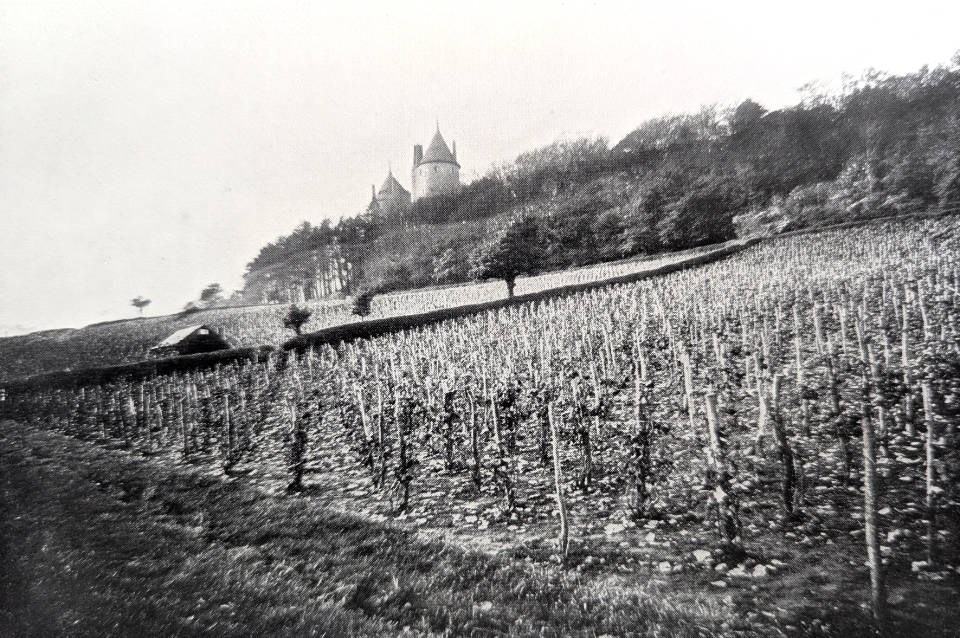
The system of training was that known as the “low-stem” system, as practised in all the colder wine-producing districts of France. Canes were pruned every winter to within a few inches of the ground, and the annual growths trained to low stakes as they developed. By these means foliage and fruit are kept close to the ground, both thus benefiting from its warmth. This system contrasts with the “high-stem” system practised in warmer countries, and almost generally in Italy, where the vines are allowed to assume their full vagabond growth upon high stakes, and the branches entwine in tangled masses and form festoons high up between vine and vine, and between row and row. But the trouble in warm climates is often to prevent over-ripening and shrivelling of the fruit.
My father has already given an account covering the early stages of the experiment in a paper read before the Naturalists’ Society in the year 1884 (see Transactions, Vol. XVI., 1884, page 6), to which my readers are referred. I need only quote here his summing up: – ” The really experimental time for the vineyard at Castell Coch has been the worst we could have hit upon for the last 20 or 30 years, and the results to be observed from the trial as yet cannot be pronounced satisfactory. There is nothing in the conditions of the soil or climate to hinder the healthy growth of the vines, but the absence of sun heat has prevented the development or ripening of the fruit. It has yet to be proved whether in a succession of ordinary good seasons a better result will be arrived at.”Surely not a very promising start, yet Lord Bute was so little discouraged that he instructed my father in 1886 to plant further vineyards on other parts of his estate, where there was any prospect of their succeeding. It was then that the Swanbridge vineyard (5 acres) was planted, on sloping land facing south-west, within half a mile of the Bristol Channel. At the same time a small vineyard was planted at St. Quentins, near Cowbridge, but this was discarded after only a few years’ trial, as the position, being open to the Channel, proved too wind-swept.
The Vine Mildew (Uncinula necator) had been noticed on occasional vines prior to 1895, but there was nothing in the nature of an epidemic. In that year, however, it broke out with such virulence at Castell Coch that the whole field was affected and the crop of fruit entirely ruined. Spraying with Bordeaux mixture – a practice replaced in later years by dusting with flowers of sulphur – henceforth became part of the regular routine work, here and at Swanbridge; but to the end the disease reappeared annually at Castell Coch, though with varying intensity, and the crops were always more or less affected. The disease did not appear as an epidemic in the more open vineyard at Swanbridge until some years later, and the effects were never so destructive. Phylloxera never made its appearance at either vineyard.
The grapes (providing there was a vintage) were usually gathered about the middle of October and transported in wagons daily to the Cardiff Castle Gardens (marked now by the Grey Friars enclosure), where were the wine shed in which the grapes were crushed, and the cellars in which the juice was fermented into wine and ultimately bottled and stored. In the early years of the experiment a simple cog-rollered mill was used, through which the bunches were passed and crushed – berries, stones and stalks together. The pulp thus produced was immediately taken to the press, and wines so produced always turned out white. In 1893, however, new apparatus was introduced. By the use of the “égrappoir,” into which the bunches were fed in bucketfuls, the berries were stripped of their stalks before being passed through rubber-coated rollers, whereby the seed-stones remained unbroken. The resulting pulp was therefore of pure fruit. New after-treatment was introduced at the same time. Before being pressed, the pulp was heaped into an immense vat, and here, during several days, the first fermentation took place. The juice, therefore, partook of the colour of the skins, and red wines resulted.
It is unnecessary here to follow the succeeding processes ending in the manufacture of the wine. Sufficient to say that these were those practised in the French wine-making districts. As to the character of the finished article it is of interest, in the first instance, to recall some of the statements published in the Press when Lord Bute’s intention to start wine-making first became known. Punch predicted, in 1875, that if ever wine was made from the vineyard it would take four men to drink it – two to hold the victim, and one to pour it down his throat. Funny Folks remarked that “Lord Bute has, it appears, a Bute-iful vineyard at Castell Coch, near Cardiff, where it is hoped such wine will be produced that in future Hock will be superseded by Coch, and the unpronounceable vintages of the Rhine will yield to the still more unpronounceable vintages of the Taff. Coch-heimer is, as yet, a wine in potentia, but the vines are planted, and the gardener, Mr. Pettigrew, expects no petty growth.”
When in due course the wines did come into being, opinions were not unfavourable. First, to quote an opinion of Lord Bute himself, as recorded in the Rt. Rev. Sir David Hunter Blair’s Memoir: “’The Mayor of Cardiff,’ Bute noted in his diary in July, 1892, ‘has bought three dozen of my 1885 wine, like, but in his opinion better (and I really think it is) than, my Falernian here.’”
“A luscious golden wine” and “resembling a first-class still champagne” were some expert comments. On the occasion of a lecture delivered by my father before the Royal Horticultural Society in 1892, a well-known chemist considered that “the samples of wine on the table were most excellent as a British production; not only of full alcoholic strength, but containing an agreeable amount of acid tartrate, as well as aroma far in advance of grape wines generally manufactured in this country.”
The labels used (see below) merely indicated the origin of the wines – Castell Coch or Swanbridge. No distinctive names were ever given to wines of different natures.

The wines were at first offered for sale through the Angel Hotel, but later directly from the Castle Gardens, at the all-round price of sixty shillings per dozen. The 1881 wine was all sold at that price, excepting a few dozens retained in the Cardiff Castle cellars. There was, however, no serious attempt made to push business until, in 1897, a well-known firm of wine merchants in London – Messrs. Hatch, Mansfield and Co. was given the agency for the sale of the wines. In their catalogue, under the heading “Welsh Wines; Canary Brand,” it is stated that “although the wines cannot yet be said to possess the delicate aroma and flavour of the best foreign wines, they are eminently honest and wholesome.” Eight sorts are enumerated with such descriptions as these: “Big soft wine, medium dry,” “full rich wine.” The prices quoted ranged from 48/- per dozen for an 1885 wine, to 36/- a dozen for a wine of 1892. Fair business resulted at first; soon, however, to fall off.
The Welsh experiment in viticulture was carried on for 45 years, that is to say, from 1875 to 1920, when the vines were finally uprooted at both vineyards and the land thrown to other uses. The late Marquis’s interest in it never flagged, and no expense was spared by him or by the present Marquis that could in any way promote its success.
During that period there were only seven years in which thorough ripening of the fruit was attained; the remaining seasons were merely indifferent, when only partial ripening was attained, or thoroughly bad, when there was no crop at all. And even in those seven years the production of sugar in the apparently mature fruit was insufficient for the requirements of fermentation! In that memorable year, 1887, considerable quantities of cane-sugar had to be added to the freshly pressed juice. In 1893, another gloriously fine year, when the record quantity of 40 hogsheads of must was produced, a deficiency of 3 degrees of saccharinity was recorded. In spite of this deficiency, Lord Bute refused to allow the addition of sugar, with the result that only a vinegary liquor was produced from that year’s vintage. Another outstanding summer was that of 1911, yet even in that year it was found necessary to add 31⁄2 lb. of cane sugar to every gallon of expressed juice. Owing to the impossibility of obtaining sugar during the War, no attempt was made at wine-making after 1914.
Cardiff lies in latitude 51.5° N., and has a mean annual temperature of 49.1° F. It may be asked why has it proved impossible to mature a good wine-producing grape here, when excellent wine is produced along the northern European line already indicated, in many parts of which the mean annual temperature is much below that of Cardiff? The answer is that the vine requires, not a high temperature averaged for the whole year, but a higher temperature and more sunlight during the summer season than our climate affords. It hardly matters how low the winter temperature falls. In the European parts referred to, the lower mean annual temperature is due to a balance between very low winter but high summer temperatures.
The conclusions to be drawn from the Glamorgan experiment would seem to be clear that here viticulture holds out no promise of success. There is obviously something wrong with the climate when even in the most favourable of seasons it has been found necessary to resort to the artificial addition of sugar, or (as in some cases) of alcohol.
Quite tolerably good wines have been made here by the expedients described, but they were not the genuine products of our soil. Moreover it is clear that they can never compete in the market with wines imported from countries enjoying more suitable climates.
Source
- Transactions of the Cardiff Naturalists Society – Volume 59 from 1926
- The Pettigrew Family History website
Images
The photo of the Pettigrew family was very kindly provided by Mr Tim Pettigrew. You can read more about the family history on Tim’s website. The Pettigrew family’s legacy in Cardiff is documented on the Cardiff Parks website.

