
Scaffolding is being erected on the Well Tower at Castell Coch for some upcoming conservation work. I happened to find a related story that happened 145 years ago this month when the castle was being reconstructed.
The South Wales Daily News reported on Friday 18th July 1879 that George Maidment had died in a tragic scaffolding accident. The incident happened on 30th June 1879.
The external construction work was nearing completion in 1879. Stone masons and labourers from the local area were working on the project for contractor, Mr A. Escourt.

This article was published in the South Wales Daily News on Friday 18th July 1879.
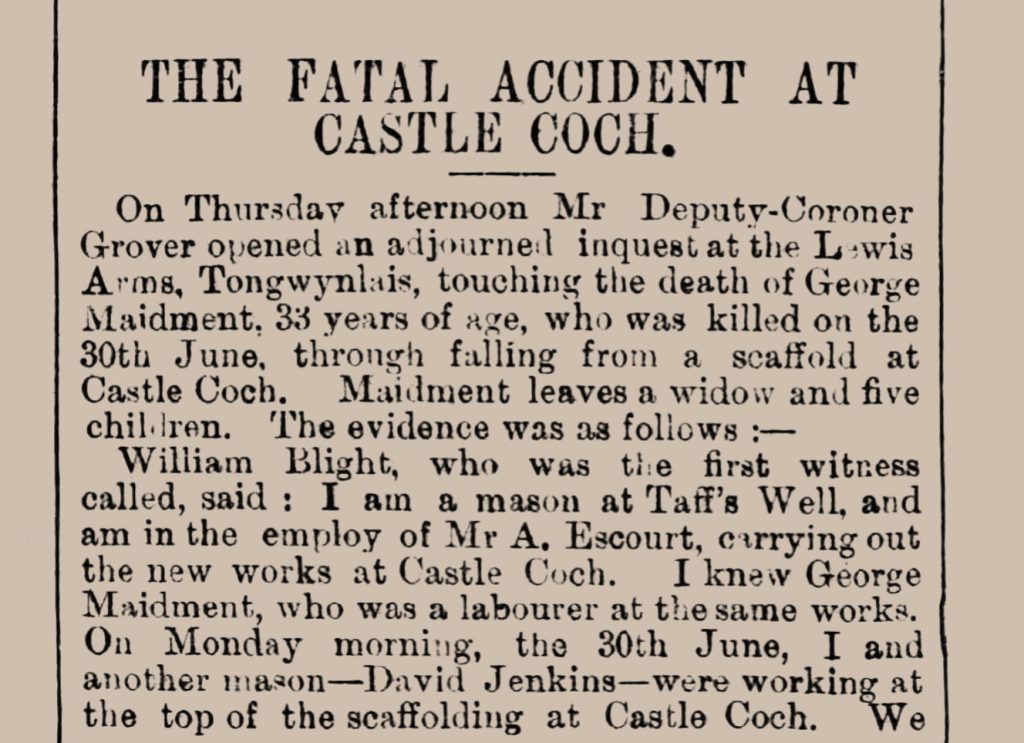
On Thursday afternoon Mr Deputy-Coroner Grover opened an adjourned inquest at the Lewis Arms, Tongwynlais, touching the death of George Maidment, 33 years of age, who was killed on the 30th June, through falling from a scaffold at Castle Coch. Maidment leaves a widow and five children. The evidence was as follows:-
William Blight, who was the first witness called, said: I am a mason at Taff’s Well, and am in the employ of Mr A. Escourt, carrying out the new works at Castle Coch. I knew George Maidment, who was a labourer at the same works. On Monday morning, the 30th June, I and another mason – David Jenkins – were working at the top of the scaffolding at Castle Coch. We were placing the stone, and Maidment was wheeling it. I told deceased he was wheeling more stones than were required, but I cannot say I was afraid of the scaffolding particularly. The answer he gave me was that “the stones there were nothing to what there would be.” I can’t say what was the meaning of his words. I went to prepare a place to put a stone in, and whilst I was giving the stone a tumble over he came on with another large stone. I can’t say – I had not a full view of him then – exactly what happened. I was on the scaffold when it fell, and was in the act of speaking to David Jenkins at the time. I saw deceased fall. The planks gave way first from the side on which deceased stood. I saw them yielding, and clung to the wall, sustaining no injury except to my eye. The accident happened about a quarter to eight o’clock, and we had been at work from six o’clock. So far as I was concerned, I thought the scaffolding was of sufficient strength, and properly constructed. This is the third time for me to be there, and I never saw anything the matter with our scaffolding before. We had told labourers many times not to put on any more stones on the scaffold, which was being overloaded.
David Jenkins, Taff’s Well, a mason in the employment of Mr Escourt, the contractor of these works – who limped into court with the assistance of a large stick – said; I was working at the Castle on the evening of the accident, Deceased was working at the same place, wheeling stones, whilst Bright and I were fixing them. The wheelbarrows were hoisted up, and generally the stones were lifted out; but this morning Maidment, in spite of repeated protests – three times over again – persisted in tipping the stones on to the scaffold. We told him that we would most assuredly go down if he did so. He made no reply, and went on tipping. At the fourth barrowful we went down. It did not strike me that this was strange conduct on the part of Maidment, for he did not generally speak much when at work. I heard the crack of the timber; made a rush to the wall, of which I had just hold by four fingers. In a second or two I slipped my grasp, and fell right to the bottom, 63 feet. The first thing I can remember is seeing Maidment lying on the ground, dead, beside me this was what I saw when I regained the consciousness I had lost in the fall.
He was about five or six feet from me, and lay with his face towards the ground, whilst I had my arm around a pole in almost a standing posture. I have been 20 years in the trade, and have frequently worked at jobs with high scaffolding. Now, I feel satisfied that this scaffolding was strong enough to bear any ordinary weight, but Maidment did not tip the stones down properly, to which cause I attribute the accident. There ought not to be sent a sudden tip on the scaffold.
James John Wright, clerk of the works to the Marquis of Bute, under Mr Escourt, contractor said: I had been on the scaffold five or six minutes previous to the accident, where Blight and Jenkins had been working. I did not then consider there was too much stone on the scaffold, and I believe there was more on the previous Saturday. I did not see the accident, but hearing a crash, and seeing the wreck below, by which, of course, I saw that the scaffolding had given way, I came out of the office. Maidment appeared dead. I tried him when he was brought into my office with a drop of brandy, but he was just at the finish. Jenkins I also saw carried away from the wreck. I considered that the scaffolding was constructed on good and sound principle, but the sudden increasing weight, two or three cwt., was enough to make any scaffold yield or give way. I am quite certain that this was the cause of the accident. If the scaffolding had not been all right I would have pointed this out.
The Deputy-Coroner summed up, and pointed out that the questions for the jury to consider were whether the scaffolding was properly constructed, or whether Maidment came by his death through his own imprudence. The jury at once returned a verdict of “Accidental Death.”
Source – Welsh Newspapers Online

