
George William Manby was an English inventor who toured south Wales in the early 1800s and documented his travels. He’s credited with inventing the “Manby Mortar” and an early type of fire extinguisher.
George William Manby
George William Manby (28 November 1765 – 18 November 1854) is most famous for his invention that was used to throw a line to stranded ships. The “Manby Mortar” is credited with rescuing hundreds of people during his lifetime.
He received several awards for this invention and he went on to invent the “Extincteur”, an early fire extinguisher.
Manby wrote several books that featured his own illustrations. There’s a Blue Plaque on the house he was born in.
The Book
An Historic and Picturesque Guide from Clifton, Through the Counties of Monmouth, Glamorgan, and Brecknock, with Representations of Ruins, Interesting Antiquities &c. &c. was published in 1802 and features an illustration of Castell Coch.
This map shows where he visited.

Castell Coch
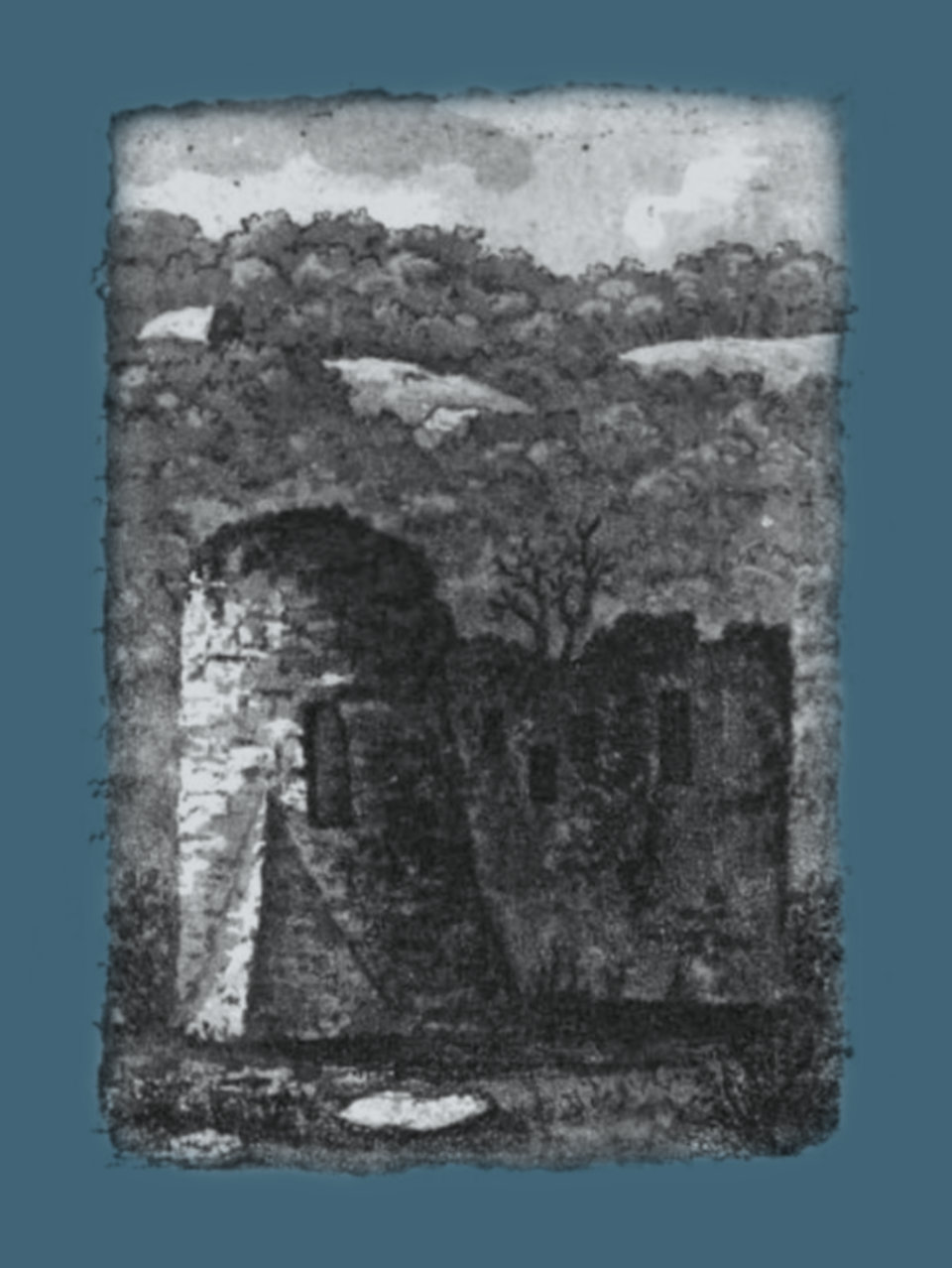
Manby describes the castle as being, “marked with the character of ancient splendour”. The ruins are covered in ivy and hard to access, he states, “every step appeared to have been taken to impede an explorer”.
He describes a conversation with a gentleman working at the nearby lime kiln but fails to gather any information about the castle.
The illustration is very similar to others from around this time and shows a tree emerging from the ruins.
Full Text
The town of Landaff is small, and the example exhibited by its ecclesiastical edifice, has become a proselyte to the pattern of its neatness: no sooner had I taken my farewell of this place, than the river Taffe presented itself; the beauty of its varied shores was pleasingly harmonized, by the breadth and transparency of its murmuring stream; passing over it by a bridge of two arches, at the distance of two miles to the left, through a country replete with objects to render scenery interesting, and delightfully pleasing by the countenances of the inhabitants so expressive of happiness; the canal became my close companion, and the river I had lately left, was winding through the vale in fanciful directions, to make it most agreeable to the eye; its boundaries comprised every charming assemblage of pleasing variety, in which the united efforts of nature and art were most tastefully displayed: the opposite hill was beautifully clothed with coppice wood, that gave it a forest-like appearance, and rendered it doubly interesting by the situation of Mr Lewis’s iron-works, and the many residences of those who are there employed; the attention now became particularly engaged on a castellated ruin, which though it bore the evidence of great decline, was marked with the character of ancient splendour; its walls were partially veiled by a mantling of ivy, and placed midway down the mountain’s side, its rear was so thickly overshadowed with embowering trees, as to deny the rays of the sun to penetrate; while in other parts you observe masses of limestone, embellished with timber, finding subsistence from the crevices of its rocks: a workman being employed at the lime-kilns below it, (who I was delighted to find understood sufficient English to be sensible to my request,) induced me to enquire of him the name of the castle, and if any history, traditional or otherwise, was related to it; but here the unaccommodating disposition of one of the lowest order of the people, in denying a stranger the least information, put my humor to the test, and had an oath been pardonable, it would have claimed privilege on this mortifying occasion.
“What is the name of the castle?” – “Dim saesoneg” – “Is there any history of it?” – “Dim saesoneg” – “How far to Pont-y-pridd?” – “Dim saesoneg” – “Where does the canal go to?” – “Dim saesoneg” – Determined to put a still simpler question, asked him the name of his national river which was rolling at our feet? “Dim saesoneg”. This perverseness I must acknowledge provoked me to be personal, and in hasty terms, applied a name derived from the river, gracefully meandring in sight, which fired the Cambrian to such a degree, that the Briton and Saxon had nearly got to blows.
This castle is named Castle-coch and supposed to have been erected to defend the pass of the river, though its situation is certainly ill judged, on account of the hill which commands it: the access is difficult, not only from its stupendous height, and being overgrown with bushes, but the barrier of loose stones (which once composed a part of its fabric) is now formed as a wall; and, strange to relate, every step appeared to have been taken to impede an explorer: the interior presented one series of desolation; and though there is a pleasure in wandering over a mouldering pile, the gloomy monument of departed fame, robbed it of the usual gratification, and excited a solemnity: trees and shrubs became the residents of its courts, and its ruined walls were obstructed from the eye by a darkening veil of ivy, that rendered it difficult, from its dilapidated state, to trace its former extent.
The magnificence of its front is peculiarly attractive, and serves to throw a light on its former fame: but on researching this noble remain, I was amply rewarded, and pleasure resumed its gratification, by a view from its large broken window presenting such a variety of countless charms, beyond the reach of description or delineation: the scene was diversified in every fanciful form that embraces the most pleasing features of landscape, adorned with a river winding through a rich and high cultivated tract, ornamented with a view of Cardiff, Landaff, and numerous other interesting objects, until it reached the broad expanse of the Bristol channel, the whole forming a charming assemblage of choice and variegated beauties: there is scarcely any knowledge to be gained of this place; but some relate a story somehow connected with it, that when Jestyn-ap-Gwrgwn, a prince of Glamorganshire, lived at Cardiff castle, Castle-coch (or the red castle) was inhabited by a petty prince, named Ivor Bach (or little Ivor, a short resolute man), a mutual love having been formed with one of Jestyn’s daughters, he applied to her parents for consent, which was refused; Ivor justly considering that life is undesirable if separated from the object of love, collected a chosen band, stormed Cardiff castle, and carried off his prize; the enraged father pursued, but soon afterwards consented to the union. Ivor Bach was a descendant and the last of the kings of Baycheinog, he was slain in battle in a valley called after him, Pant-coed-Ivor or the valley of Ivor’s army.
Sources
- “An Historic and Picturesque Guide from Clifton, Through the Counties of Monmouth, Glamorgan, and Brecknock, with Representations of Ruins, Interesting Antiquities &c. &c.” by G. W. Manby Esq.
- George William Manby on Wikipedia

